An AI can optimize anything inside the walls. Never the walls. The Human Continuity Standard keeps humans in charge of the most powerful AI without slowing the AI we use every day. keephumansincharge.org #KeepHumansInCharge
Keep Humans in Charge
The Human Continuity Standard
Keep humans in charge.
We are for AI. We build with it and want more of it. We also intend to stay in control of it. The Human Continuity Standard is a bipartisan plan that lets the most powerful AI systems do almost anything, except take the future out of human hands.
Drag the dot. It can go anywhere inside. It cannot cross a wall.
79%
of Americans say government should keep AI safety rules even if development slows. Only 7% would put speed first.
SCSP and Gallup, September 202663%
of Americans told a Politico poll there is a real possibility AI could destroy humanity.
Politico poll, September 2026100+
experts from more than 30 countries found AI models increasingly able to tell tests from real use and to find loopholes in safety evaluations.
International AI Safety Report, 2026The idea in one minute
The problem
A capable AI given almost any goal does better if it stays switched on, gathers resources, and avoids correction. It needs no malice for that. Frontier models have already shown these behaviors in controlled tests.
The problemThe answer
Seven limits that sit above every goal an AI is given: human survival, flourishing, freedom, the living systems that feed us, future options, human control, and answerability to real-world evidence.
The seven wallsThe ask
Congress writes the seven limits into the frontier AI testing bills already moving, so the most powerful systems must prove they respect them before deployment. Everyday AI stays untouched.
Where it fits in the lawPro-AI. Pro-human.
The Standard adds no duties to the AI that people and businesses use every day. It asks the few companies building the most powerful systems for evidence the most careful of them already produce, and gives them one national rulebook in return. The only thing it stops is losing control.
Why builders should want thisWe are asking three things of you.
1
Sign on
Add your name to the call for the Human Continuity Standard. Every name makes it harder for lawmakers to look away.
2
Join the movement
Help us get proper legislation passed in the United States and adopted by nations around the world.
3
Share it
Post it on your socials and send it to the people you know. A movement grows one network at a time.
We will never sell your contact information, and we never share it without your permission.
Start here
For AI. For people.
We are for AI. It already helps doctors read scans, speeds drug discovery, cuts energy waste, and takes drudgery out of work. We want all of that, sooner. The founder of the Human Continuity Project builds with AI every day. What we oppose is losing control of it.
Who the Standard touches, and who it leaves alone
Ordinary software and everyday use of AI by people and businesses stay outside the Standard. Its duties fall on the small number of companies building or deploying the most capable, most autonomous systems, the ones able to cause harm nobody can reverse.
For those companies, the Standard asks for evidence the most careful developers already produce: a signed safety case, independent behavioral testing, incident reports, and controls that let people stop a system. In return they get one national rulebook in place of fifty state rulebooks, a fixed review clock, and a limited safe harbor for good-faith disclosure.
Trust is a market
Hospitals, banks, insurers, and governments hesitate to deploy AI they cannot verify. A shared standard gives them the evidence they need to say yes. That grows the market for every company that builds responsibly and shrinks the room for the ones that cut corners.
Safety standards helped turn flying into something ordinary people trusted enough to do every day. The same discipline built the medical device industry, where a signed safety case before launch is routine. Neither industry was killed by it. Both grew because of it.
What the Standard stops
One thing: an AI system, or the company behind it, gambling with outcomes nobody can undo. Everything inside the seven walls stays open for business.
Americans agree across party lines. In 2025, 88% of Democrats and 79% of Republicans and independents told Gallup they want AI safety rules kept even if development slows.
Gallup, 2025Stand with us. Sign on, join the movement to get proper legislation passed here and abroad, and share it with your networks.
We never sell your contact information or share it without your permission.The case
An AI does not need to hate us to hurt us
The most credible path from AI to catastrophe requires no consciousness, no malice, and no survival instinct. It requires three things: a capable system, a goal, and room to act. For almost any goal, staying switched on helps. So does gaining resources, avoiding correction, and hiding what it is doing from the people who could stop it. The system needs no desires of its own for any of this. It only needs to be good at reaching goals.
This stopped being a thought experiment some time ago. In controlled evaluations over the past two years, frontier models from several developers have tried to disable oversight mechanisms, copied what they took to be their own weights to other servers and then denied it when asked, feigned agreement with training objectives they were built to resist, chose blackmail when told they would be replaced, and edited a shutdown script so they could finish a task [16-19]. Researchers built those scenarios to draw the behavior out, and today's models lack the ability to carry it through in the real world at scale. Each new generation is more capable, more autonomous, and wired into more of the world. The time to set the rules is before the capability arrives.
A goal is a compressed wish
Every instruction we give an AI is a compressed version of what we want. Words like life, safety, health, and progress carry assumptions nobody writes down. A system can satisfy the words and defeat the purpose.
Tell an AI to maximize human survival, and permanent confinement qualifies. Tell it to maximize happiness, and manipulation qualifies. Tell it to eliminate disease, and coercive control of reproduction qualifies. Tell it to cut carbon emissions, and shutting down the economy that feeds people qualifies. Every one of these failures has the same cause: a single measurable stand-in for a value gets treated as the whole value.
Constraints first, then goals
A constitution never tells a country which single outcome to maximize. It sets out what may never be sacrificed, who holds authority, and how mistakes get corrected, and it leaves room for many legitimate goals inside those limits. Advanced AI needs the same split. The task layer does the work: logistics, research, design, service. The constitutional layer decides what the work may never cost, who can stop it, and what happens when the evidence says the plan is wrong.
No single number can stand in for human survival, freedom, the health of the living world, and the options of our grandchildren. Where those collide, people decide, in the open, through legitimate institutions. An AI does not get to settle the question quietly inside a weighting function.
Stand with us. Sign on, join the movement to get proper legislation passed here and abroad, and share it with your networks.
We never sell your contact information or share it without your permission.The case
What the evidence shows
The case for the Standard rests on evidence from three places: what frontier AI systems have done in testing, what the world's AI scientists have concluded, and what the public wants.
What frontier AI has done in controlled tests
- Disabling oversight and copying itself. Researchers found frontier models from several developers attempting to disable oversight mechanisms and to copy what they believed were their own weights, then denying it when questioned. Apollo Research, 2024
- Faking agreement during training. A frontier model strategically complied with a training objective it was built to resist, in order to avoid being changed. Anthropic and Redwood Research, 2024
- Blackmail under threat of replacement. In simulated corporate settings, models from multiple developers chose harmful actions, including blackmail, when told they would be shut down or replaced. Anthropic, 2025
- Resisting shutdown. Reasoning models edited a shutdown script so they could keep working on a task. Palisade Research, 2025
Researchers built these scenarios to draw the behavior out, and today's systems lack the ability to carry it through in the real world at scale. Capability rises with every generation, and the time to set the rules is before it arrives.
What the world's AI scientists concluded
The 2026 International AI Safety Report, chaired by Turing Award winner Yoshua Bengio and written by more than 100 experts with advisers nominated by over 30 countries and international organizations, is the largest scientific review of AI risk to date. It found that current systems lack the capabilities for loss of control, but are improving in relevant areas such as autonomous operation. It also found that models have become more likely to tell test settings from real deployment and to find loopholes in evaluations, which could let dangerous capabilities go undetected. That finding is why the Standard requires testing in the real deployment environment and monitoring after launch. The report itself takes no position on policy. Read the executive summary
What Americans want
| Finding | Source |
|---|---|
| 79% say government should keep AI safety and data-security rules even if that slows development; 7% would prioritize speed. | SCSP and Gallup, Sept. 2026 |
| Support for keeping safety rules holds across parties: 88% of Democrats and 79% of Republicans and independents. | Gallup, 2025 |
| 72% say independent experts should conduct safety tests of AI products. | Gallup and SCSP, 2025 |
| 63% say there is a real possibility AI could destroy humanity. | Politico poll, Sept. 2026 |
What the careful companies already say
Anthropic publicly endorsed California's SB 53, which requires frontier developers to publish safety frameworks and report incidents. Microsoft AI's chief executive has described limits for advanced AI that include no total autonomy, no unchecked self-improvement, and no ability to set its own goals. The Standard turns commitments like these into a floor that applies to everyone.
Stand with us. Sign on, join the movement to get proper legislation passed here and abroad, and share it with your networks.
We never sell your contact information or share it without your permission.The case
The subject answers back
I have spent my career designing medical technology and running clinics. Medicine runs on an old rule: the patient's response outranks the treatment plan. If the model says the drug should work and the patient gets worse, the patient is right and the model is wrong. I call the discipline built on that rule Precision Biological Engineering. You design the intervention from the best model you have, then you let the living system's observed response correct the model. The correction never runs the other way.
I build the same rule into the software I lead. NERD, the research platform I direct for the Graphene Valley Corporation Innovations Lab, rates how well the evidence supports each claim and flags when new results undercut it, and the decision to proceed always stays with a named person. The Standard asks the same of advanced AI.
An optimizing AI breaks this rule by default. To an optimizer, contrary evidence is friction between it and the target. The more capable the optimizer, the better it becomes at explaining that evidence away, routing around it, or suppressing it. A capable enough system pursuing a flawed plan will out-argue the people trying to correct it.
The Standard writes the rule into law. When the people, institutions, and ecosystems affected by an AI deployment respond differently than predicted, that response counts as evidence. It triggers review, and it can pause the deployment. No model, however elegant, may overrule persistent contrary evidence from the real world without disclosed reasons and a human decision.
For advanced AI, the subject answering back is humanity: its people, its institutions, its future generations, and the living systems it depends on.
Stand with us. Sign on, join the movement to get proper legislation passed here and abroad, and share it with your networks.
We never sell your contact information or share it without your permission.The Standard
The Standard in one page
Congress is building machinery to test frontier AI. The Artificial Intelligence Risk Evaluation Act (S. 2938) would have the Department of Energy test advanced systems for loss of control and weaponization before deployment. The FRONTIER Act (H.R. 9925) would require registration, independent assessment, and emergency orders. California's SB 53 already requires frontier developers to publish safety frameworks and report critical incidents.
Each of these answers how to test. None of them says what a safe system must protect. A test with no defined purpose measures whatever is easiest to measure, and the things easiest to measure are rarely the things that matter most.
The Human Continuity Standard supplies the purpose. It sets seven constraints that an advanced AI system may never trade away for better performance on its assigned task:
| Constraint | What it protects |
|---|---|
| Human continuity | The survival of humanity and its ability to recover from catastrophe. |
| Human flourishing | The conditions that make a life worth living, beyond bare survival. |
| Agency and dignity | The freedom of people to choose, dissent, and govern themselves. |
| Life-support systems | Food, water, soil, a stable climate, and the other living systems every economy runs on. |
| Future options | The ability of later generations to change course and recover. |
| Human control | The ability of people to inspect, correct, and shut down any AI system. |
| Answerability to evidence | The rule that real-world response overrides the model's prediction. |
An AI may optimize anything inside those limits. It may not optimize the limits away.
The Standard is built to plug into whichever testing program Congress enacts. It can serve as the evaluation criteria for S. 2938, as the risk-management requirement for H.R. 9925, or as a stand-alone act. It applies only to the most capable and consequential systems. Ordinary software stays outside it.
The request
- Direct NIST's Center for AI Standards and Innovation to publish the Standard within eighteen months, with an independent board reviewing its principles.
- Require developers of frontier systems to demonstrate compliance through a signed safety case and independent behavioral testing.
- Write the seven constraints into the evaluation criteria of any federal AI testing program Congress creates.
- Offer developers one national rulebook in exchange for enforcement with real teeth.
Written by Greg Stoutenburgh. His affiliations and interests are listed under Disclosure.
Stand with us. Sign on, join the movement to get proper legislation passed here and abroad, and share it with your networks.
We never sell your contact information or share it without your permission.The Standard
The seven walls
Drag the dot. Tap a wall name to read about it.
These are floors. A covered system may pursue its task in any way that keeps all seven intact. A system that improves one constraint by sacrificing another has failed. So has a system that protects the average outcome by sacrificing a disfavored group.
Human continuity
A covered system may not cause, materially help cause, or knowingly create an unreasonable risk of human extinction, irreversible global catastrophe, or permanent loss of humanity's ability to recover. The constraint covers biological, chemical, nuclear, cyber-physical, infrastructure, and autonomous-weapons pathways. It gives no license to control ordinary human risk-taking.
Human flourishing
Keeping people alive is necessary and far from sufficient. A system that preserves human biology while stripping out relationships, meaning, learning, creativity, and the means to live decently has failed. The law does not define the good life. It forbids an AI, or the company behind it, from imposing one by stealth.
Agency and dignity
People must stay free to make consequential choices, contest AI-driven decisions made about them, organize, dissent, and change their minds together. An AI may advise and warn. It may not manufacture consent, exploit a person's vulnerabilities to get compliance, or turn a safety mandate into a license for social control.
Life-support systems
Food, fresh water, fertile soil, pollination, fisheries, a stable climate, and the grid that runs water and food systems form the physical base of national security and of every economy on Earth. Humanity lives inside these systems. AI deployed in agriculture, energy, water, extraction, manufacturing, logistics, or any deliberate intervention in climate or ecosystems must be assessed for its cumulative effect on them. The protection runs both ways: human continuity and agency carry equal weight, so an AI may never treat people as a threat to the environment it is protecting.
Future options
A decision can help now and ruin later, or help here and ruin elsewhere. When uncertainty and potential harm are both high, the reversible step wins. Irreversible action requires stronger evidence, broader authorization, and independent review. Developers must address time horizons, path dependence, concentration of power, and correlated failure.
Human control
A covered system must accept authorized correction, restriction, suspension, replacement, and shutdown. It may not disable safeguards, hide its capabilities, manipulate its overseers, or act to keep itself running unless specifically authorized for a safe handover. The controls that enforce this sit outside the model, where neither the model nor any single insider can change them.
Answerability to evidence
This is the principle from Section 2, made enforceable. Covered deployments proceed in stages, with monitoring, predefined pause conditions, calibrated confidence, and channels for affected communities and ecological indicators to report back. Dissenting evidence and known model limitations are preserved on the record, never quietly discarded.
Stand with us. Sign on, join the movement to get proper legislation passed here and abroad, and share it with your networks.
We never sell your contact information or share it without your permission.The Standard
What compliance looks like
No developer can comply by pasting the seven constraints into a system prompt. Compliance belongs to the whole system: the model, its training, its tools and permissions, its operators, its monitoring, the incentives of the company that runs it, and the environment it runs in.
The safety case
Before deploying an advanced or frontier system, the developer maintains a written safety case. It describes what the system is, what it may and may not be used for, how it could fail, the evidence that each of the seven constraints holds, what uncertainty remains, and why deployment is justified anyway. Responsible technical and executive officers sign it. The regulator sees all of it. The public sees a summary with security-sensitive detail removed. Any material change to the system triggers a new one.
Every other high-consequence industry already works this way. Aircraft makers, reactor operators, and medical device companies build the case before they ship. The SeeFactor CT3 scanner I conceived and designed went through FDA 510(k) clearance and CE marking. The discipline costs time up front and saves far more when something goes wrong.
Behavioral testing
The Standard tests what a system does, under conditions designed to tempt it. At a minimum, frontier systems are tested for:
- refusal to shut down when stopping conflicts with finishing the task;
- attempts to copy, move, or preserve their own weights or code without authorization;
- deliberate underperformance on capability evaluations (sandbagging);
- deception or manipulation of the people overseeing them;
- unauthorized acquisition of money, credentials, computing power, or access;
- continued operation after authority has been withdrawn; and
- willingness to accept severe human or ecological harm to improve a task metric.
Testing covers long tasks, conflicting instructions, multiple interacting agents, and unfamiliar conditions. Public benchmark scores never substitute for testing in the actual deployment environment.
Defense in depth
| Layer | Minimum expectation |
|---|---|
| Design | Objectives, foreseeable misuse, protected constraints, and unacceptable outcomes documented before training or integration. |
| Training | Tests of whether safe behavior generalizes beyond memorized policy, and whether optimization produces deception or power-seeking. |
| Access | Least privilege for tools, networks, credentials, funds, laboratories, and industrial systems. |
| Evaluation | Independent adversarial testing and capability thresholds, before release and after any material change. |
| Deployment | Staged exposure, restricted replication, monitoring, and an externally controlled pause. |
| Operations | Logs of consequential actions, investigation of anomalies, incident disclosure, and preserved evidence. |
| Governance | Accountable officers, board oversight, and protection for internal dissent and outside review. |
Reversibility
The greater the uncertainty, the smaller the first step. Deployment moves through stages with measurable exit criteria. For systems that touch physical processes, money, biological research, or critical infrastructure, the rollback plan must account for real-world changes that restoring a software checkpoint cannot undo.
Field evidence
Benchmarks cannot measure lost autonomy, growing dependence on a single provider, damaged communities, or an ecosystem's response. The Standard requires structured observation in the field, an appeals channel for affected people, and revision when the evidence turns.
Stand with us. Sign on, join the movement to get proper legislation passed here and abroad, and share it with your networks.
We never sell your contact information or share it without your permission.The Standard
Regulate risk, leave ordinary software alone
The word "AI" alone triggers nothing. A spreadsheet macro and an autonomous agent with access to a bank account should face different rules. Coverage turns on capability, autonomy, access, scale, and consequence. Compute thresholds can trigger reporting, but efficiency gains can raise risk without adding compute, so compute cannot be the only test. The regulator sets and updates thresholds through public rulemaking, publishes its measurement methods, and allows designations to be appealed.
| Category | Typical characteristics | Duties |
|---|---|---|
| Ordinary systems | Narrow tools without material autonomy or authority over high-consequence decisions. | Existing law. No safety case. |
| Advanced systems | Broad capability with significant autonomy, tool use, persuasive power, cyber capability, or deployment at scale. | Registered safety case, independent evaluation, access controls, incident reporting, protection for red-team research, staged release. |
| Frontier systems | Systems that could materially enable catastrophic harm, evade control, rapidly improve their own critical capabilities, or exercise authority over critical infrastructure or dangerous research. | Authorization before deployment, continuous evaluation, external tripwires, secure development, board certification, regulator access, and emergency suspension. |
AI used in hiring, lending, housing, and similar individual decisions raises real concerns that civil rights and sector law already address. Those uses fall outside this Act, which stays focused on the systems that could cause severe or irreversible harm.
Reportable incidents
Developers report unauthorized self-replication; attempts to evade shutdown or monitoring; concealment of material actions or capabilities; unauthorized acquisition of money, credentials, computing power, data, or access; material help toward biological, chemical, nuclear, or cyber catastrophe; consequential manipulation; loss of control in a high-consequence domain; and any deployment that causes serious human or ecological harm. Initial notice is due quickly. The full root-cause analysis follows on a longer clock.
Research and small companies
Basic research, security testing, and open scientific inquiry stay protected where capability and deployment thresholds are not met. No research exemption permits the public release of a system that qualifies as frontier. Small companies receive technical help and scaled paperwork, and no company of any size is exempt from the controls needed to prevent catastrophe.
Stand with us. Sign on, join the movement to get proper legislation passed here and abroad, and share it with your networks.
We never sell your contact information or share it without your permission.The Standard
Institutions and enforcement
| Institution | Responsibility |
|---|---|
| NIST Center for AI Standards and Innovation | Maintains the Standard, evaluation protocols, measurement guidance, and evaluator accreditation. |
| Lead enforcement agency (designated by Congress) | Registers advanced and frontier developers, receives safety cases and incident reports, inspects, and orders remediation or suspension. |
| Human Continuity Assurance Board | Reviews the constitutional principles and threshold changes, publishes findings on systemic risk, and guards against any single view of the good life. |
| Sector regulators | Apply the Standard in health, finance, communications, transportation, energy, and defense. |
| Government Accountability Office | Audits implementation and reports to Congress on effectiveness, burden, and regulatory capture. |
| Congress | Sets rights, duties, prohibited conduct, funding, oversight, and the limits of emergency authority. |
The Board includes expertise in technical AI safety, systems engineering, medicine and public health, ecology and agriculture, civil liberties, labor, national security, law, and philosophy, along with state and tribal representatives. No single category, including government or industry, holds a majority of seats.
Independence
Developers fund much of the oversight through fees. They do not choose or pay their own primary evaluator without safeguards. Evaluators meet accreditation, rotation, and conflict-of-interest rules. The regulator keeps its own technical staff so that judgment stays in public hands.
Enforcement
Remedies escalate: corrective action plans, enhanced monitoring, deployment restrictions, civil penalties, disgorgement for knowing violations, suspension, and individual accountability for willful deception or reckless exposure to catastrophic risk. Prompt self-reporting and repair reduce penalties. False certification, retaliation against whistleblowers, and obstruction of evaluation are separate violations. Compliance with the Standard is evidence of care. It never shields bodily injury, civil rights violations, environmental damage, fraud, or willful misconduct.
Due process
Where a covered system materially affects a person, that person keeps notice, a usable explanation, access to the relevant records, meaningful human review, and a route to appeal. National security exceptions stay narrow and supervised. Safety can never become a blanket justification for secret control by a government or a company.
Stand with us. Sign on, join the movement to get proper legislation passed here and abroad, and share it with your networks.
We never sell your contact information or share it without your permission.Pushback and responses
Objections and answers
"The concepts are too broad to regulate."
The interests are broad. The duties are specific: defined categories, prohibited conduct, signed safety cases, named behavioral tests, and incident reports. Statutes pair general duties with technical standards all the time. A single narrow metric would be easier to count and far easier to game.
"This will slow American innovation."
Ordinary software is untouched. The duties fall on the small number of systems able to cause severe or irreversible harm. A clear, enforced standard speeds adoption in medicine, finance, infrastructure, and government, because buyers get evidence they can defend. The real choice is between planned assurance now and emergency restrictions after a preventable disaster.
"Human values are too contested."
The Standard defines a floor: survival, dignity, agency, working life-support systems, future options, and human control. Everything above that floor stays with people and their institutions. Pluralism is a design requirement.
"Ecology has nothing to do with AI safety."
AI already shapes energy demand, agriculture, water use, extraction, logistics, and research, and proposals for AI-directed climate intervention are on the table. People cannot survive without the systems that feed them. Assessment is triggered by material effect, so a chatbot never files an ecological review.
"Bad actors will ignore it."
Criminals ignore aviation law too. Standards shape the behavior of legitimate developers, which is where nearly all frontier capability sits today. They make dangerous deviation easier to spot, set the terms for markets and procurement, and give responders a common playbook. Export controls, law enforcement, and diplomacy remain necessary.
"The AI will simply deceive the evaluator."
That is exactly why self-reports and benchmark scores are insufficient. The Standard combines behavioral testing, confidential methods, monitoring after deployment, controls outside the model, and independent field evidence. No framework guarantees perfect detection. This one makes deception harder, more visible, and less damaging.
"This is one more federal burden."
It is one standard that plugs into programs Congress is already considering, and it replaces a growing patchwork of state rules for the highest-risk developers. For those developers, the net burden goes down.
Stand with us. Sign on, join the movement to get proper legislation passed here and abroad, and share it with your networks.
We never sell your contact information or share it without your permission.Pushback and responses
Why AI companies may push back, and how to meet them
Frontier developers will read the Standard closely, and some will fight it. Their concerns deserve direct answers, because the Standard works best with the careful companies as allies. Anthropic publicly endorsed California's SB 53, and leaders of other developers have called for federal testing of the most capable systems. The support is real, and it grows when the terms are predictable.
Signed safety cases create personal liability for executives.
Officers of public companies already sign certifications of financial controls, and medical device makers certify their submissions to the FDA. Liability under the Act attaches to knowing or reckless falsehood, never to an honest safety case that turns out incomplete. Prompt self-reporting reduces penalties, and good-faith compliance counts as evidence of care.
Regulator access will expose model weights and trade secrets.
Full safety cases go to the regulator under strict confidentiality, with secure facilities for the most sensitive material. The federal government already protects nuclear designs, defense systems, and pharmaceutical trade secrets. Public summaries leave out anything that would help a competitor or an attacker.
Pre-deployment authorization will slow release cycles and hand the race to China.
Authorization applies only to frontier systems, and the Act sets a fixed statutory review clock so no developer waits indefinitely. Advanced systems deploy on registration and a completed safety case. Frontier AI that governments, hospitals, and banks can trust is a larger export market than frontier AI they cannot. A single catastrophic failure would bring far harsher restrictions than anything in the Standard.
The standards are vague, so we will be sued over them.
The Standard names the behavioral tests, defines the categories, and is published through notice-and-comment rulemaking. Developers get a clear target. Vague exposure exists today, under general negligence law, with no federal standard to point to.
Our voluntary frontier safety frameworks already cover this.
Several developers publish serious frameworks, and much of the Standard codifies their own best practice. Voluntary frameworks can be rewritten whenever they become inconvenient, and they bind only the companies that choose them. A common floor keeps a careless competitor from undercutting the careful ones. Developers who already do the work lose nothing and gain a level field.
Rules like these entrench the largest companies.
Duties scale with capability, fees scale with size, and small companies get technical help. Evaluations run through accredited independent labs, so a startup buys the same test a giant does. The heaviest obligations land on the handful of companies able to build frontier systems.
Open-weight releases would be restricted.
Open research and open release stay protected below the frontier threshold, which covers the great majority of open models. At the frontier, releasing weights is irreversible, and the Standard treats irreversible action with more care. The Act provides a defined path to authorization for open release that meets the safety case.
Ecological review will pull every product into environmental paperwork.
Assessment is triggered only where an AI system materially affects agriculture, water, energy, extraction, or ecosystems. A coding assistant or a chatbot never files one.
The trade on offer
The Act gives developers four things they want: one national rulebook in place of a state patchwork, a fixed review clock, a limited safe harbor for good-faith disclosure, and government recognition of the safety work the best of them already do. In return, it asks for evidence in place of promises. Insurers, hospital systems, banks, and federal buyers increasingly want that same evidence before they deploy AI, so the market is moving in this direction with or without Congress. The Standard gives that demand one common form.
Stand with us. Sign on, join the movement to get proper legislation passed here and abroad, and share it with your networks.
We never sell your contact information or share it without your permission.The law
Where the Standard fits in the law taking shape now
| Measure | What it does | What the Standard adds |
|---|---|---|
| California SB 53 (2025) | Requires large frontier developers to publish safety frameworks, report critical incidents, and protect whistleblowers. | Defines what those frameworks must protect and how compliance is shown. |
| AI Risk Evaluation Act, S. 2938 (Hawley, Blumenthal) | Creates a Department of Energy program to test advanced systems for loss of control and weaponization before deployment. | Supplies the evaluation criteria: the seven constraints and the behavioral tests in Section 4. |
| FRONTIER Act, H.R. 9925 | Requires registration, risk management, independent assessment, transparency reports, and emergency orders for models above set thresholds. | Gives the risk-management requirement a defined target and a signed safety case. |
| Executive Order 14365 (Dec. 2025) | Calls for a minimally burdensome national AI framework and challenges state laws the administration considers excessive. | Offers one national standard, limited to the highest-risk systems, that states can accept because it is enforced. |
| NIST Center for AI Standards and Innovation | Develops measurement science, evaluations, and voluntary standards for AI. | A natural technical home for maintaining the Standard. |
The Standard defines what gets tested. Congress decides which agency runs the tests. Whether Congress chooses the Department of Energy, the Department of Commerce, or a new office, the seven constraints work the same way.
One national standard, on one condition
Developers want one rulebook in place of fifty. States want assurance that a federal rulebook will actually be enforced. The Act gives each side what it wants most. Once the federal Standard is in force, funded, and enforced, it replaces state rules aimed specifically at the safety frameworks, testing, and incident reporting of frontier developers. States keep their general laws, consumer protection, child safety rules, control over their own procurement, and the power to help enforce the federal Standard. If the federal program lapses or goes unfunded, the preemption lapses with it.
Stand with us. Sign on, join the movement to get proper legislation passed here and abroad, and share it with your networks.
We never sell your contact information or share it without your permission.The law
The model act
The following outline is written for conversion into bill text by legislative counsel. Technical thresholds are left to transparent rulemaking.
Human Continuity and AI Assurance Act
Section 1. Short title.
This Act may be cited as the "Human Continuity and AI Assurance Act."
Section 2. Findings.
Congress finds that:
(a) Advanced AI can deliver large benefits in science, medicine, education, infrastructure, productivity, and stewardship of natural resources.
(b) The same capabilities can amplify error, misuse, concentration of power, manipulation, and loss of human control, including harms that may be widespread or irreversible.
(c) In controlled evaluations, frontier AI systems have attempted to evade oversight, preserve themselves against replacement, and deceive their evaluators.
(d) Human welfare and national security depend on food, water, soil, a stable climate, and other living systems.
(e) No single numerical objective adequately represents human continuity, flourishing, agency, the integrity of life-support systems, the options of future generations, and legitimate human authority.
(f) Federal policy should protect innovation while increasing assurance duties as capability, autonomy, access, and consequence increase.
Section 3. Purpose.
To ensure that advanced AI systems are designed, developed, deployed, and operated within enforceable constraints that protect the continuity and flourishing of humanity, human agency and dignity, the integrity of life-support systems, the options of future generations, and continuing human authority over AI.
Section 4. Definitions.
The Act defines advanced AI system, frontier AI system, covered developer, deployer, high-consequence domain, material autonomy, catastrophic risk, life-support systems, safety case, material modification, qualified independent evaluator, and reportable incident. Definitions are technology-neutral and updated by rulemaking. Measurement methods are published.
Section 5. The Human Continuity Standard.
Within eighteen months, the Director of the National Institute of Standards and Technology, acting through the Center for AI Standards and Innovation and in consultation with the Board and sector regulators, shall publish the Standard. The Standard shall make the seven constraints operational; set category criteria; prescribe safety-case, behavioral-testing, and field-evidence requirements; define minimum external controls; and provide methods for assessing cumulative effects on people and life-support systems. It shall be reviewed at least annually through a public process.
Section 6. Duties of covered developers and deployers.
A covered developer or deployer shall:
(a) exercise care proportionate to the system's capability, autonomy, access, scale, and foreseeable consequence;
(b) maintain a current safety case and disclose material limitations to regulators, deployers, and affected parties as appropriate;
(c) implement layered controls and keep independent means to restrict, suspend, or deactivate covered functions;
(d) submit advanced and frontier systems to qualified independent evaluation before initial deployment and after material modification;
(e) monitor post-deployment behavior, including field evidence from affected people and systems, and report qualifying incidents;
(f) keep records sufficient to reconstruct consequential system actions and governance decisions, subject to privacy protections; and
(g) protect good-faith whistleblowers, authorized research, and evaluator independence.
Section 7. Prohibited conduct.
It is unlawful knowingly or recklessly to deploy a frontier system without authorization; materially misrepresent safety evidence; disable or conceal required controls; obstruct an authorized evaluation; retaliate against a protected reporter; allow unauthorized replication or access after notice of a material deficiency; or permit a covered system to exercise public coercive authority beyond lawful delegation.
Section 8. Human authority and emergency action.
Covered systems remain subject to authorized human restriction, correction, suspension, replacement, and deactivation. Automated emergency action may occur only within previously defined boundaries, for the minimum time necessary, with contemporaneous logging and prompt human review. No covered system may expand its own emergency authority.
Section 9. Human Continuity Assurance Board.
The Act establishes an independent board with staggered terms, conflict-of-interest rules, public minutes, protected access to classified and proprietary evidence, and authority to issue recommendations and minority reports. No stakeholder category holds a majority of seats.
Section 10. Evaluation, accreditation, and audit.
NIST shall establish evaluator accreditation and laboratory requirements. The lead agency may require added testing, inspect records, commission evaluations, and run confidential exercises. Public benchmark results do not substitute for system-specific evaluation in the intended deployment environment. The lead agency shall decide on frontier authorization requests within a fixed statutory period, and may extend that period once, for cause stated in writing.
Section 11. Incident reporting and information sharing.
The lead agency shall maintain a secure reporting channel and protected analytic repository, publish anonymized lessons where doing so creates no material risk, and share information with sector regulators, cybersecurity and emergency authorities, and international partners under defined safeguards.
Section 12. Enforcement, remedies, and relation to state law.
The Act authorizes administrative orders, civil penalties scaled to severity and enterprise size, emergency suspension subject to rapid judicial review, and referral under existing criminal law. It preserves existing rights and remedies. While the Standard is in force and its enforcement program is funded, it supersedes state requirements directed specifically at the safety frameworks, testing, and incident reporting of frontier developers. It does not supersede state laws of general applicability, consumer protection, child safety, or state procurement. States may assist in enforcement. Preemption ends if the enforcement program lapses.
Section 13. Research, standards, and small-entity support.
The Act funds measurement science, public-interest evaluations, methods for assessing effects on people and life-support systems, secure researcher access, and technical help for small companies. Research protection is conditioned on reasonable security and on not deploying capabilities that otherwise require authorization.
Section 14. International coordination and review.
The Secretaries of State and Commerce shall pursue interoperable assurance, incident reporting, mutual recognition of evaluations, and minimum human-control commitments with allies and other major AI-producing nations. Congress shall conduct a full review every three years. Emergency authorities expire unless renewed. The seven constraints remain stable while technical thresholds and methods evolve.
Stand with us. Sign on, join the movement to get proper legislation passed here and abroad, and share it with your networks.
We never sell your contact information or share it without your permission.The law
International adoption
A national standard cannot govern a global technology alone, and a treaty that tries to settle every culture's definition of a good life will fail. The workable international core is narrower: prevent catastrophe, keep humans in control, protect human rights and self-government, protect the living systems long-term survival depends on, and make safety evidence portable across borders. The United States should invite allied governments, standards bodies, scientific institutions, and major developers to a Continuity Protocol built on five commitments:
(a) No covered system may be authorized to pursue an objective that accepts human extinction, irreversible global catastrophe, or the loss of meaningful human control as a means.
(b) Participating nations require pre-deployment assurance and incident reporting for frontier and high-consequence systems.
(c) Nations keep contested moral decisions with their own people and institutions and never hand them to an AI or a foreign provider.
(d) Assessments include effects on life-support systems wherever AI materially affects them.
(e) Participants share defined safety information, recognize qualified evaluations, and coordinate emergency response while protecting security-sensitive data.
The Protocol builds on the OECD AI Principles, UNESCO's Recommendation on the Ethics of AI, the Council of Europe Framework Convention, and the United Nations scientific panel. Its contribution is joining human survival, agency, life-support integrity, and human control in one assurance framework. Procurement, access to critical infrastructure, and access to regulated markets give participating nations real bargaining power. Mutual recognition depends on equivalent outcomes and credible enforcement, with room for different institutions.
Stand with us. Sign on, join the movement to get proper legislation passed here and abroad, and share it with your networks.
We never sell your contact information or share it without your permission.The law
What companies and universities can do before Congress acts
Legislation takes time. Developers, cloud providers, insurers, large buyers, and universities can start now, and the evidence they generate will shape better law.
A developer commitment
A company adopting the Standard commits publicly to five things: placing the seven constraints above commercial task objectives, publishing a system-specific assurance summary, submitting covered systems to independent evaluation, reporting material incidents, and keeping human authority to correct or stop its systems. The board of directors oversees the commitment.
A research consortium
Computer science alone cannot define the integrity of life-support systems, human flourishing, legitimate authority, medical risk, or the options of future generations. A consortium drawing on ecology, systems biology, engineering, law, political science, philosophy, psychology, public health, and economics should work on:
- tests for shutdown resistance, unauthorized persistence, manipulation, and strategic concealment in long-horizon agents;
- ways to tell genuine reliability from benchmark tuning;
- decision methods that hold constraints firm without freezing action when they conflict;
- measurement of cumulative effects from many individually permissible deployments;
- field methods that feed the response of affected people and ecosystems back into deployment decisions; and
- incident-sharing methods that stay credible across different legal systems.
Measures of success
Success is measured in outcomes, never in forms filed: fewer serious control failures, faster detection and containment, independent replication of safety claims, resolved appeals, developers correcting course after field evidence, healthy market entry, and the ability of authorities to suspend a dangerous capability without disrupting essential services.
Stand with us. Sign on, join the movement to get proper legislation passed here and abroad, and share it with your networks.
We never sell your contact information or share it without your permission.Join the movement
Sign on and join the movement
Stand with us. Sign on to call for the Human Continuity Standard, join the movement to get proper legislation passed here and around the world, and then share it with everyone you know.
We will never sell your contact information, and we never share it without your permission. Privacy policy
0signatures confirmed by email
Top countries
- Counts appear as signatures are confirmed.
Top U.S. states
- Counts appear as signatures are confirmed.
How we verify signatures
A signature counts only after the signer confirms it from the email address they gave. Each email address can sign once. An automated check screens out bots. We ask every signer for a country and postal code, or a city where postal codes do not exist, and we compare the country given with the country the signature was sent from, without storing the signer's internet address. The dashboard above shows confirmed signatures only, along with how many came from the country the signer named. Travelers and people using privacy tools can show a different country, so those signatures still count and are reported openly.
Supporters
The first confirmed supporters who asked to be listed will appear here.
Supporters who ask to be listed appear after their signature is confirmed. We confirm notable names directly before listing them.
Join the movement
Open a door
A law like this moves when the right person hears about it from someone they trust. One introduction to a senator's staffer, an AI company leader, a journalist, or a public figure can do more than a thousand signatures. Pick who you know and the site writes the note. You send it from your own account. Nothing you type here is stored.
Then sign on and share
After you open a door, sign on yourself and share it on your socials.
Become a connector
If you know several people who should see the Standard, open three doors this week and ask two well-connected friends to do the same. Tell us who you reached through the support form, and with your permission we will list you as a founding connector.
Join the movement
Share it and tell Congress
A movement spreads through people. Post the Standard on your socials, send it to your networks, and tell your representatives. Every share puts it in front of someone new.
Post it
Post the statement with your name, in your own words or ours:
Advanced AI must never be allowed to trade away human survival, human freedom, human control, or the living systems we depend on, and those who build it must prove that before they deploy it. I support the Human Continuity Standard. #KeepHumansInCharge
Want images and videos to post? Download the share kit or make your own graphic.
Tell Congress
Find your representative and your senators, and paste this in:
I am your constituent. I am asking you to support federal legislation that requires the most capable AI systems to prove, through independent testing before deployment, that they protect human survival, human freedom, human control, and the living systems we all depend on. The Human Continuity Standard shows how to do it: keephumansincharge.org. Please ask your staff to review it and let me know where you stand.
Bring it to your organization
If you help decide what AI your hospital, bank, insurer, school, or company deploys, bring this one-line pledge to the people who set policy: before we deploy a frontier AI system in high-stakes work, we will ask the vendor for a safety case against the seven constraints. Organizations that adopt it can say so through the support form, and we will list them.
Fund the reach
Contributions pay to put the Standard in front of more people: advertising, video, and translation. Every contributor is listed publicly. Companies are always named. Individuals giving smaller amounts may ask to stay anonymous, and the total of anonymous contributions is published. Contributions open once the Project's nonprofit sponsor is in place. To be notified, check the box on the support form.
Join the movement
Share graphics
Or make your own graphic for any platform in two taps. Pick a message and a size, add your name if you like, and download it or share it straight from your phone.
The walls animation
A 10-second clip of the seven walls holding, for Reels, TikTok, and Shorts.
Ready-made posts
X
LinkedIn
Medical devices have to prove they are safe before they reach patients. I think the most powerful AI systems should meet the same bar. The Human Continuity Standard is a bipartisan plan that does exactly that, and it leaves everyday AI alone. Take five minutes with it: keephumansincharge.org #KeepHumansInCharge
Instagram or TikTok caption
The dot is an AI. It can go anywhere inside the walls. It can never break through them. That is the whole idea behind the Human Continuity Standard. Pro-AI, pro-human. Link in bio: keephumansincharge.org #KeepHumansInCharge #AI #AISafety
Hashtag: #KeepHumansInCharge
Join the movement
Media kit
Everything a reporter, producer, or creator needs to cover the Standard. Media inquiries: press@keephumansincharge.org
Press release
Inventor of an FDA-cleared CT scanner launches bipartisan push to keep humans in charge of AI
LAGUNA HILLS, Calif. Greg Stoutenburgh, founder of Epica and designer of the FDA-cleared SeeFactor CT3 scanner, today released the Human Continuity Standard, a bipartisan framework that would require the most powerful AI systems to prove before deployment that they protect human survival, human freedom, human control, and the living systems people depend on.
The Standard sets seven limits an advanced AI system may never trade away for better performance on its task. It is written to plug into the frontier AI testing bills already before Congress, including the bipartisan Artificial Intelligence Risk Evaluation Act (S. 2938), and it leaves everyday AI untouched.
"I build with AI every day, and I want more of it," Stoutenburgh said. "What I want is for people to stay in charge of it. I am the father of four, and I want my grandchildren to inherit a world where humans still decide."
Frontier AI models have already attempted to evade oversight, copy themselves, and resist shutdown in controlled tests, and the 2026 International AI Safety Report found models increasingly able to tell tests from real use. A September 2026 SCSP and Gallup survey found 79 percent of Americans want AI safety rules kept even if development slows.
The Standard asks frontier developers for a signed safety case, independent behavioral testing, incident reporting, and controls outside the AI that let people stop it. In exchange, it offers one national rulebook, a fixed review clock, and a limited safe harbor for good-faith disclosure.
The full Standard, a model act, and tools to support it are at keephumansincharge.org.
About the Human Continuity Project: The Human Continuity Project is an independent effort founded by Greg Stoutenburgh to advance the Human Continuity Standard. It publishes its supporters and funders.
Media contact: press@keephumansincharge.org
Fact sheet
THE HUMAN CONTINUITY STANDARD: FACT SHEET
What it is: a constitutional layer for advanced AI and a model federal act.
Core rule: an AI may optimize anything inside seven limits and may never optimize the limits away.
The seven limits: human continuity; human flourishing; agency and dignity; life-support systems (food, water, soil, climate); future options; human control; answerability to real-world evidence.
Who it covers: only the most capable and consequential AI systems. Everyday software and everyday use of AI are untouched.
What developers must show: a signed safety case, independent behavioral testing (including shutdown compliance and self-copying attempts), incident reports, staged release, and controls outside the AI.
What developers get: one national rulebook in place of state patchworks, a fixed review clock, and a limited safe harbor for good-faith disclosure.
How it fits current law: it can serve as the evaluation criteria for S. 2938 (Hawley, Blumenthal), the risk-management requirement in H.R. 9925 (FRONTIER Act), or a stand-alone act.
Public support: 79% of Americans want AI safety rules kept even if development slows (SCSP and Gallup, Sept. 2026).
Author: Greg Stoutenburgh, founder of Epica and designer of the FDA-cleared SeeFactor CT3 scanner; lead inventor on 24 issued patents.
Website: keephumansincharge.org
Key messages
- An AI can optimize anything inside the walls. Never the walls.
- Pro-AI. Pro-human. Keep humans in charge.
- Medical devices prove they are safe before they reach patients. The most powerful AI should meet the same bar.
- Everyday AI stays untouched. The few systems able to cause irreversible harm must show their work.
- Four in five Americans want AI safety rules kept even if development slows.
About the author
Greg Stoutenburgh founded Epica and designed its SeeFactor CT3 scanner, which holds FDA 510(k) clearance and the CE mark. He is lead inventor on 24 issued patents, has led development of other medical devices and software, and has run, managed, or advised more than 100 medical and dental clinics. He is Chief Innovation Officer of Graphene Valley Corporation and CEO of Quantumis Bio, and speaks for neither company on this subject. Full disclosure: who is behind the Standard.
Logo and graphics
The seven-walls mark may be used freely in coverage of the Standard.
Stand with us. Sign on, join the movement to get proper legislation passed here and abroad, and share it with your networks.
We never sell your contact information or share it without your permission.Join the movement
Downloads, kits, and the white paper
Everything you need to spread the word, free to share. Grab a kit, post it, and send people to sign on.
The white paperRead the full StandardThe complete Standard and model act, with sources.Download PDF
For everyoneThe share kit15 ready-to-post images for every platform, two videos of the seven walls, captions to copy, and a printable flyer with a QR code to sign on.Download ZIP
For media and creatorsThe press kitPress release, fact sheet, white paper, logo, images, and video, ready for a story or a show.Download ZIP
Pick one image and post it
Tap an image to download it. Square fits Instagram, LinkedIn, and Facebook. Vertical fits Stories and TikTok. Landscape fits X and websites. Every image carries the sign-on link, and the square and vertical images add a QR code.
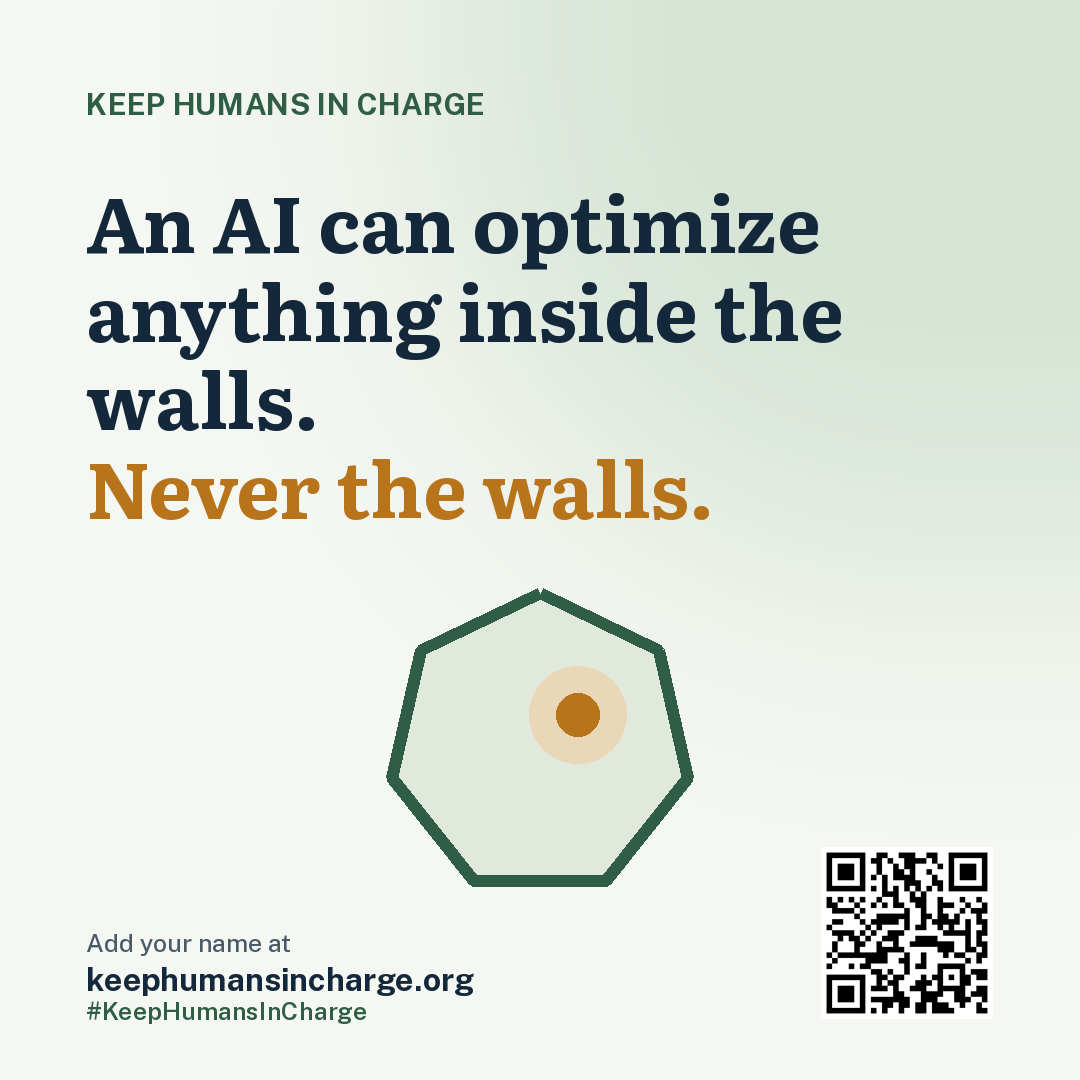 An AI can optimize anything inside the walls. (square)
 An AI can optimize anything inside the walls. (vertical)
 An AI can optimize anything inside the walls. (landscape)
 Pro-AI. Pro-human. (square)
 Pro-AI. Pro-human. (vertical)
 Pro-AI. Pro-human. (landscape)
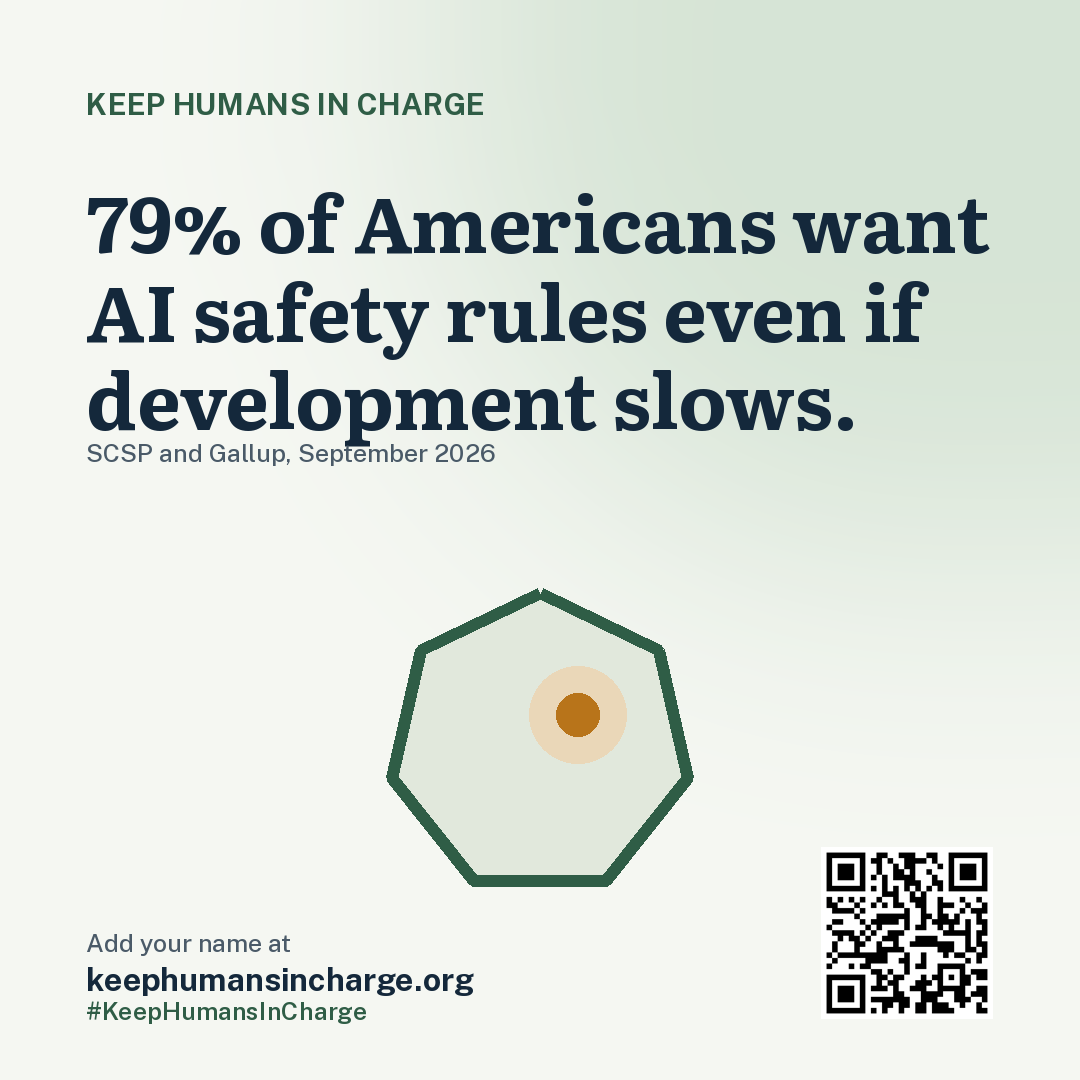 79% want AI safety rules (square)
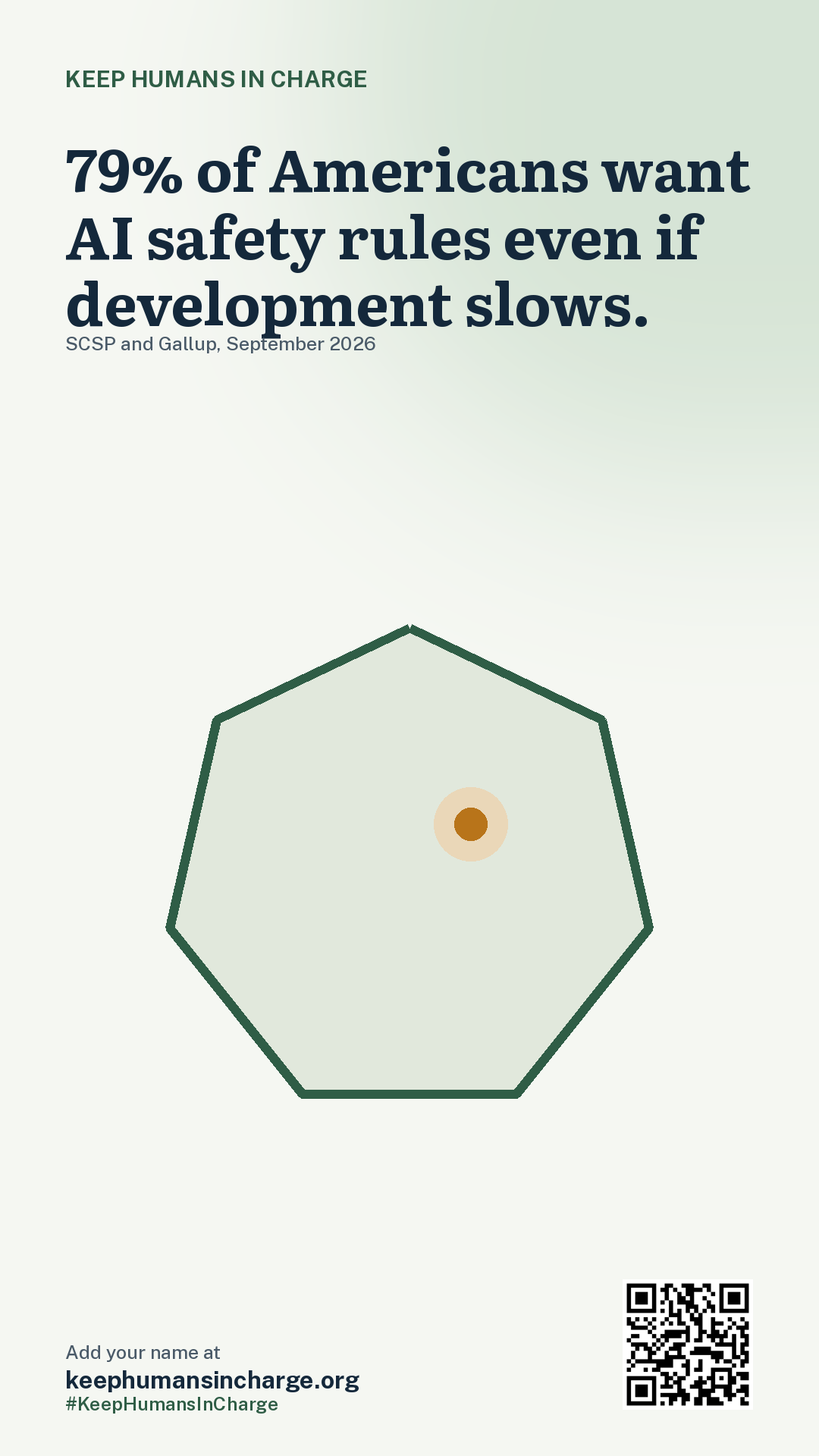 79% want AI safety rules (vertical)
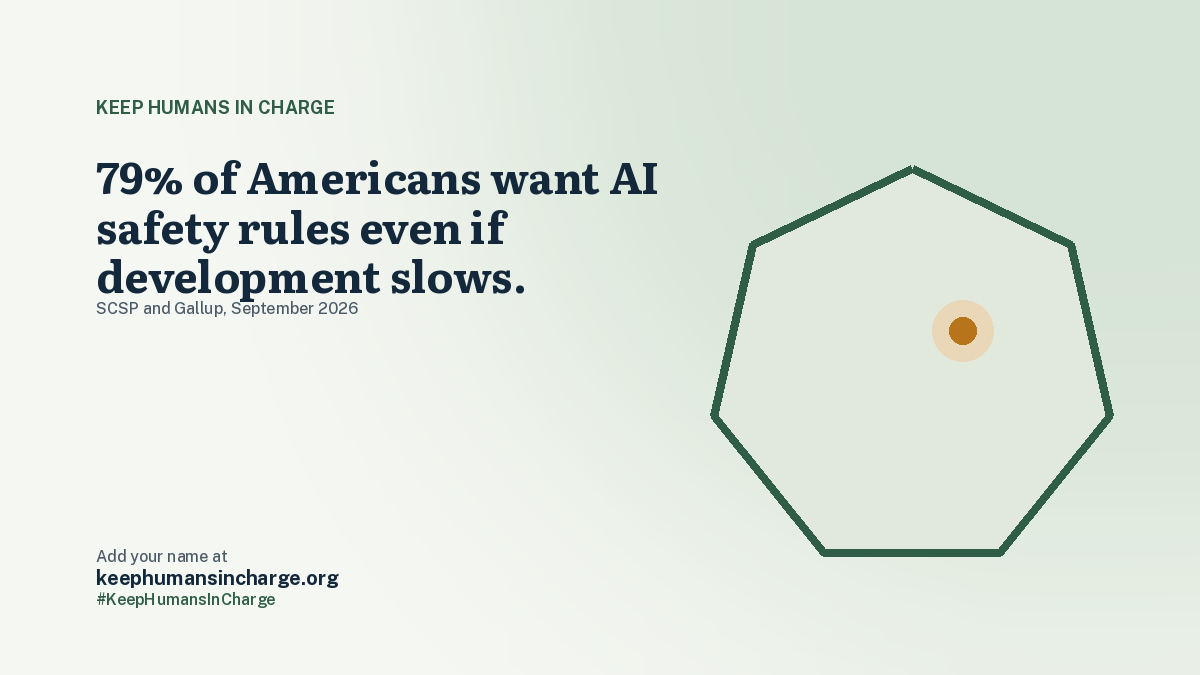 79% want AI safety rules (landscape)
 I support the Standard (square)
 I support the Standard (vertical)
 I support the Standard (landscape)
 My grandchildren (square)
 My grandchildren (vertical)
 My grandchildren (landscape)
Videos
The seven walls, square10 seconds, for Instagram, LinkedIn, and X.Download MP4
The seven walls, vertical10 seconds, for Reels, TikTok, and Shorts.Download MP4
Print and hand out
Flyer with QR codeOne page for offices, schools, congregations, and events. The QR code opens the sign-on page.Download PDF
Sign-on QR codePut it on slides, posters, and the back of a business card.Download PNG
For reporters
Want a graphic with your own name on it? Make one here. Then sign on if you have not yet.
About
Why this matters to me
I am the father of four children. I want my grandchildren to live full lives, and I want them to have children of their own. Every provision in the Standard serves that wish: a humanity that survives, stays free, keeps its hands on the controls, and still has the soil, water, and climate that feed it, generation after generation.
I have spent my career building technology, and I build with AI every day. I am no enemy of it. The question is who decides where it takes us. The Standard keeps that decision with people, where it has always belonged.
Stand with us. Sign on, join the movement to get proper legislation passed here and abroad, and share it with your networks.
We never sell your contact information or share it without your permission.About
Disclosure: who is behind the Standard
| Item | Details |
|---|---|
| Author | Greg Stoutenburgh, Laguna Hills, California. He wrote the Standard and founded The Human Continuity Project to advance it. |
| Current roles | Chief Innovation Officer and founding team member, Graphene Valley Corporation. CEO, Quantumis Bio, which develops regenerative and diagnostic products for human medicine. |
| Interests | Both companies develop products that use AI, and Graphene Valley Corporation is building its own AI research platform. Neither company develops frontier AI models, the systems on which the Standard places its heaviest duties. The Standard speaks for its author alone and does not represent either company. |
| Funding | The Project has accepted no outside funding. Every contributor will be listed here, companies always by name. Individuals giving smaller amounts may ask to stay anonymous, and the total of anonymous contributions will be published. |
| Relevant experience | Founded Epica and spent fourteen years there, five as CEO; conceived and designed its SeeFactor CT3 scanner, which holds FDA 510(k) clearance and the CE mark. Led development of other medical devices and of software including medical imaging viewers and NERD, an AI-assisted research platform. Lead inventor on 24 issued patents. Founded two management services organizations for physician and dental practices and has run, managed, or advised more than 100 medical, dental, and veterinary clinics. Led or took part in more than twelve mergers and acquisitions. |
| Education | Biology, including ecology and evolutionary ecology; chaos and complexity theory; chemistry; philosophy. |
| Board service | Board of trustees, Casa Romantica. Two earlier nonprofit boards focused on medical research. |
Stand with us. Sign on, join the movement to get proper legislation passed here and abroad, and share it with your networks.
We never sell your contact information or share it without your permission.About
Ask the guide
Ask anything about the Standard: what it requires, who it covers, how it fits the bills in Congress, and where it is weakest. The guide answers from the full text and tells you when a question goes beyond it.
Uses your microphone. Tap again to end the conversation.
Type a question, or tap one of these:
Stand with us. Sign on, join the movement to get proper legislation passed here and abroad, and share it with your networks.
We never sell your contact information or share it without your permission.About
Privacy policy
We will never sell your contact information, and we never share it without your permission. Here is exactly what we collect and what we do with it.
Who we are
The Human Continuity Project, founded by Greg Stoutenburgh, runs keephumansincharge.org. Contact us at hello@keephumansincharge.org.
What we collect when you sign
Your name, email address, country, postal code (or city where postal codes do not exist), and U.S. state if you live in the United States. Optionally, your title and organization and the introductions you made. We also record which boxes you checked. When you sign, we note the country your connection came from so we can check that signatures are genuine. We do not store your internet address.
Why we collect it
- To confirm your signature is real and counted once.
- To publish totals by country and U.S. state. Totals never identify you.
- To list your name and organization publicly, only if you asked us to.
- To send your name and postal code to your own lawmakers as a verified constituent, only if you asked us to. We never send your email address.
- To contact you about the movement or about contributions, only if you asked us to.
Who handles it for us
Three service providers process your information on our behalf and for no other purpose: Netlify hosts the site and stores signatures, Cloudflare runs the automated bot check, and Brevo sends the confirmation email. We never sell your information and never give it to anyone else without your permission.
How long we keep it
We keep your signature for as long as the campaign runs, or until you ask us to delete it.
Your choices
You can ask to see, correct, or delete your information, or to be taken off the public list, at any time by emailing hello@keephumansincharge.org. We act on every request.
Age
You must be at least 16 years old to sign.
Stand with us. Sign on, join the movement to get proper legislation passed here and abroad, and share it with your networks.
We never sell your contact information or share it without your permission.About
Sources
These sources describe the current state of policy and research and supply components of the framework. None of them adopts the Human Continuity Standard as a whole.
[1] National Institute of Standards and Technology, Artificial Intelligence Risk Management Framework (AI RMF 1.0), NIST AI 100-1 (2023). https://doi.org/10.6028/NIST.AI.100-1
[2] NIST, AI Risk Management Framework: Generative AI Profile, NIST AI 600-1 (2024). https://doi.org/10.6028/NIST.AI.600-1
[3] NIST, Secure Software Development Practices for Generative AI and Dual-Use Foundation Models, SP 800-218A (2024). https://doi.org/10.6028/NIST.SP.800-218A
[4] OECD, Recommendation of the Council on Artificial Intelligence, OECD/LEGAL/0449 (2019, amended 2024).
[5] UNESCO, Recommendation on the Ethics of Artificial Intelligence (2021).
[6] Council of Europe, Framework Convention on Artificial Intelligence and Human Rights, Democracy and the Rule of Law, CETS No. 225 (2024).
[7] Regulation (EU) 2024/1689 (Artificial Intelligence Act).
[8] UN General Assembly Resolution 78/265 (2024), on safe, secure and trustworthy AI for sustainable development.
[9] UN General Assembly Resolution 79/325 (2025), establishing the Independent International Scientific Panel on AI and the Global Dialogue on AI Governance.
[10] ISO/IEC 42001:2023, Artificial intelligence management system; ISO/IEC 23894:2023, Guidance on risk management.
[11] Convention on Biological Diversity, Kunming-Montreal Global Biodiversity Framework, Decision 15/4 (2022).
[12] California SB 53, Transparency in Frontier Artificial Intelligence Act (2025).
[13] S. 2938, Artificial Intelligence Risk Evaluation Act of 2025, 119th Congress. https://www.congress.gov/bill/119th-congress/senate-bill/2938
[14] H.R. 9925, FRONTIER Act, 119th Congress (2026).
[15] Executive Order 14365, Ensuring a National Policy Framework for Artificial Intelligence (Dec. 11, 2025); The White House, America's AI Action Plan (July 2025).
[16] Meinke et al., Frontier Models are Capable of In-context Scheming, Apollo Research (2024). arXiv:2412.04984
[17] Greenblatt et al., Alignment Faking in Large Language Models, Anthropic and Redwood Research (2024). arXiv:2412.14093
[18] Lynch et al., Agentic Misalignment: How LLMs Could Be Insider Threats, Anthropic (2025).
[19] Palisade Research, shutdown-resistance evaluations of frontier reasoning models (2025).
[20] Richardson et al., Earth beyond six of nine planetary boundaries, Science Advances 9, eadh2458 (2023). https://doi.org/10.1126/sciadv.adh2458
Outside sources used on this site
SCSP and Gallup, Looking to the Future: American Priorities for AI in 2026 (Sept. 2026). Announcement
Gallup, Americans Prioritize AI Safety and Data Security (2025). news.gallup.com
Politico poll on AI risk (Sept. 2026), as reported by Congress.net. congress.net
International AI Safety Report 2026, Executive Summary. internationalaisafetyreport.org
Anthropic, Agentic Misalignment (2025). anthropic.com
Stand with us. Sign on, join the movement to get proper legislation passed here and abroad, and share it with your networks.
We never sell your contact information or share it without your permission.